How to Optimize B2B SaaS Content for AEO
The advice for AEO content is consistent: lead every section with a direct answer, use full entity names and word associations, include specific data points, and add FAQ sections. Follow that checklist & your content has a shot at being cited in ChatGPT or Perplexity AI when a buyer asks about your category.
The challenge with this is that everyone’s running the same checklist on a Claude Project or custom GPT. And the content coming out of it is starting to look identical (structured, extractable, and roughly as memorable as a software license agreement).
My process starts with the checklist because it works, and I’ll explain why. But I add a second layer by citing original data and using the buyer’s exact language to articulate their pain point. I’ve found that answer engines prefer these because it makes the content come off as relevant in the category.
Why AEO Matters for B2B SaaS Right Now

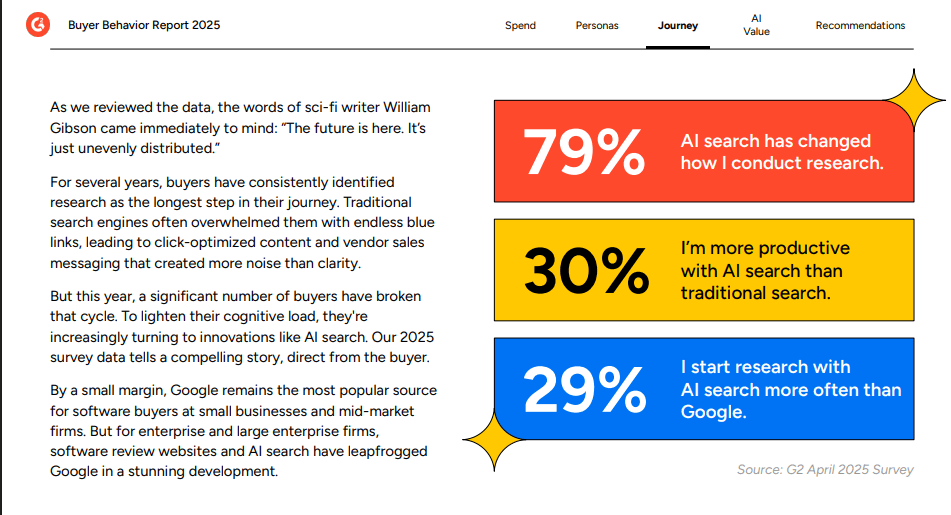
8 in 10 respondents in a G2 buyer behavior survey say AI search has changed how they conduct research. 29% of these start their research via answer engine platforms more often than Google.
And according to Aleyda Solis’s AI search study, 52% of AI Overview citations come from pages that don’t appear in the top 50 traditional search results. Ahrefs also found that 12% of links cited by ChatGPT, Gemini, & Copilot overlapped with Google’s top 10 results for the same prompts — meaning four out of five AI citations go to pages with no meaningful Google ranking at all.

So if you’re not optimizing for visibility on answer engines, you may lose out on the few users who rely on these platforms during their buying decisions.
True, AI traffic is still small. But when you check LinkedIn and X, a lot of marketers say their clients (or companies) got high-quality leads from ChatGPT, Claude, and other LLMs. To me, it’s a good enough reason to be a bit more intentional about AI search, especially when it means changing a few things about how you structure your content before publishing it.
The Five Structural Properties of AEO Content: How I Optimize for AEO
I may use the word “AEO article” a lot. By it, I mean answer engine optimized articles.
1. Write Direct Answers First
Every section of an “AEO article” should start with the claim (not the context). This is the typical bottom-line-up-front (BLUF) model that many content leaders prefer.
Kevin Indig, a growth advisor for SaaS brands, also analyzed 1.2 million ChatGPT citations and found that 44.2% of all citations come from the first 30% of content. The bottom 10% of any page earns only 2.4 – 4.4% of citations. This shows that opening of each section is where the retrieval system scans the most.

Indig also noticed that opening with a direct declarative statement in the form “(X) is (Y)” or “(X) does (Z)” helps achieve an extra 14% increase in how often the AI tool cites that content overall (i.e., an aggregate citation lift). So the more direct you are, the better.
How I do it:
In an article for a client, I wrote this opening to the H2 “What is regression testing?”
“Regression testing ensures that previously developed features or actions perform as expected after developers made changes to the code.”

The editor wanted it the way it is published, & I understood from the POV that it’s what the reader expects to see. Not a preamble or unnecessary context about why regression testing is a practice in the QA circle.
The objection: “Won’t leading with the answer kill the reader’s curiosity?”
Rarely. Readers who land on a regression testing guide already know they have a problem. They most likely aren’t even interested in the definition because they already know. They’re more interested in how to perform regression testing and would skim through an intro if it offers no value.
How to apply it: Read your article section by section. If each new section doesn’t open with something specific about the heading, rewrite it.
2. Full Entity Names Throughout (and Use Word Association in Context)
Every time a company, product, person, or named concept appears in your content, use its full, official name consistently (for example, “Zapier” instead of just “the automation platform,” or “Paddle” instead of just “the payment system”). This helps answer engines recognize and connect the correct entity, which improves chances of being pulled and cited.
Kevin Indig’s study on how AI pays attention found that heavily cited text averaged 20.6% entity density — about three to four times the 5 – 8% entity density of typical English text. Among entity types, date entities (specific years, quarters, and publication dates) were the strongest universal citation signal, followed by number entities (percentages, counts, and dollar figures).

These signals show that a claim is specific and verifiable, which even makes them reliable to a human reader. For answer engines and retrieval systems designed to surface this kind of output, it is coffee for their morning.
The mechanism is that when an LLM retrieves content & generates an answer, it matches your content to the query using entity names. If you write “they announced a 40% improvement,” the model can’t reliably associate that claim with any company. But if you write “HubSpot announced a 40% improvement in XYZ in Q3 2024 after using Salesforce (or your specific tool),” the model can extract, attribute, & cite that claim with confidence.
In other words, you’ve used an entity (e.g. your company) and associate it with a use case or a feature that’s relevant to your target audience. & Answer engine tools are able to easily extract & cite you when a user asks for a related query.
How I do it:
Instead of writing this way: “The platform lets users create client portals. Once they sign in, they can review deliverables & leave feedback.”
You’re encouraged to write this way, like I did for a client recently: “ManyRequests lets agencies create white-labeled client portals. Once clients sign into ManyRequests, they can review deliverables and leave timestamped feedback directly inside the platform.”
The latter version has a clear, extractable association between ManyRequests & the use case. When a buyer asks ChatGPT “which tools let agencies create client portals,” ManyRequests has a higher chance of being cited. I decided to check, and …that’s my client, y’all!

How to apply it: After your V1 draft, search the document for “they,” “it,” “this,” “the platform,” “the tool” & other variants. Where appropriate, replace each of these pronouns with their names so the LLMs have a word association with the use case you’ve described.
Want this kind of result for your website? Let’s talk — I am available to take on two retainers.
3. Specific, Citable Data Points
LLM citation engines extract claims that can be verified & attributed to a specific source. The more precisely a claim is stated, the more distinctly citable it becomes.
A 2024 Princeton GEO study tested specific content modifications across 10,000 queries. Adding statistics improved AI search visibility by 41%. Adding external citations — linking to the original sources — improved visibility by 115% for lower-ranked content.
These interventions work because they give AI systems something to verify & attribute. The broader principle applies to any specific, verifiable claim — not just statistics. A named study, a dated finding, a precise percentage, a quoted source; all of these are more citable than a paraphrase or a generalization of the data point.
For example, rather than write “Our survey found that most buyers consult multiple sources before purchasing,” it’s better to phrase your report as “Our 2025 SaaS Buyer Behaviour Report, which surveyed 640 B2B decision-makers across North America, found that 78% consult at least five independent sources before shortlisting a vendor.”
This is the exact thing G2 did when they published their Buyer Behavior report:
“In G2’s 2025 Buyer Behavior Report, I dive deep into findings from an online survey of 1,169 B2B decision-makers fielded by G2 in April 2025.”

Anyone can paraphrase what your report says. But if you’re the publisher, phrasing it this way can help with AEO. It also helps the reader (who found it via Google or social) understand the sample size of your survey without looking for the methodology in your report.
How I source the data:
Obviously, I try to affiliate my client’s product with the relevant use cases I cite. And when I am explaining a pain point, I use the buyer’s own words from G2, Capterra, and Trustpilot so that whenever a user is using those same (or related) phrases, the LLM would understand how my client’s product is a relevant alternative for the problem. Using the reviewer’s exact words also helps for query matching.
4. FAQ Sections
A well-structured FAQ section is the format closest to what LLMs were trained to extract from. Each question-answer pair maps to a single user intent & a single extractable passage. Some call it atomic content, meaning each unit is self-contained & answerable without the sections around it.
Adding a FAQ page (&/or a FAQPage schema) gives AI systems a machine-readable index of every Q&A on your page. The system doesn’t need to infer which text is a question & which is an answer, the schema tells it. FAQs also address the long-tail sub-queries that query fan-out generates, which is good, because every query leads to more queries to unpack.
How I write FAQ sections:
To find my queries, I use “People Also Ask” results for the primary keyword, community discussions on Reddit (LinkedIn and Facebook helps too) where buyers describe their actual problems, & G2 & Capterra reviews.
I then use that intent to write a straightforward answer, which was hard to do at first, because it’s easy to fall into the “it depends” angle as the first clause.
It’s easier now, because I understand that the first sentence of every FAQ answer is what they extract; the explanation afterwards helps the AI see our value. This is basically the same way some SEOs gamed featured snippets in the past — because we knew those first 40-60 words can increase CTR.
How to apply it: Keep your FAQ answers to 60–100 words each. One question, one answer, one chunk. Don’t bundle related questions into a single answer; the system needs each to stand alone.
5. Internal Linking Architecture and Consistency Across Your Site
LLMs don’t evaluate individual pages in isolation. They cross-reference multiple pages from the same domain; which means a site where every piece is structured for AEO builds citation authority faster than one where the internal linking approach is inconsistent.
Kevin Indig’s citation research found that the top 10 domains in any topic capture 46% of all citations. The top 30 control 67%. This shows that topical authority accumulates for domains where every piece signals credibility. And it takes time for LLMs to understand these patterns.
Aleyda Solis’s AI search optimization checklist identifies topical breadth & depth — pillar-cluster content with deliberate internal linking — as core to AEO. So if you have a cluster of content on the same topic, you can help Google and AI tools better understand your site architecture by running an effective internal linking structure.
How I manage this:
Good old internal linking. I ensure that every article I write has relevant anchor texts to other articles that can help a reader experience the company more. Articles/pages that add more context to the existing piece. By doing that, I help LLMs (& Google) understand the site architecture.
I also built MyLinks, an internal linking tool, to recommend internal links for my drafts. I use it for my clients, and it makes adding internal links faster.

This is for this article. & as you can see, MyLinks recommends links that make sense for the context of my article. I can either accept or reject the recommendation. & like Grammarly, when I accept a recommendation, it autoscrolls to the next one. I don’t have a lot of pages on my site but it still managed to find pages that are contextually related to the anchor texts.
The goal is a site where every content cluster is fully connected. An AI system that retrieves one page from your domain & finds credible links to other relevant pages is more likely to cite across the cluster, not just the single page.
…
Your buyers are already in ChatGPT, asking questions about your category. If you want your brand in the answer — I have two retainer spots open.
Frequently Asked Questions
1. Is AEO the same as GEO (Generative Engine Optimization)?
AEO & GEO are the same practice with different names. They both describe structuring content so generative AI systems can assess, retrieve, & cite it. A lot of practitioners use the terms interchangeably but they mean the same thing.
2. Does AEO replace SEO?
AEO does not replace SEO; it works as the cherry on top of a solid SEO. AI Overviews still pull roughly 76% of their citations from pages already ranking in Google’s top 10, and while ChatGPT and Perplexity AI cite far more broadly, with only about 11–12% of their cited URLs overlapping with Google’s top‑10 results, strong SEO is still the base of answer engine optimization.
3. What type of B2B SaaS content gets cited most by ChatGPT & Perplexity?
ChatGPT and Perplexity often cite “best of” lists, side‑by‑side comparison content, pricing breakdowns, product documentation, and step‑by‑step implementation guides. They also seem to favor thought leadership content, first party data, and use case hubs.
4. How long does it take for AEO content to get cited?
For well‑structured AEO content on a reasonably authoritative site, you can start seeing AI citations within 1–6 weeks, with meaningful, measurable citation volume typically building over 8–12 weeks (about 2–3 months).
5. Do I need to rewrite all my existing content for AEO?
A full rewrite isn’t necessary for most existing content. You can (1) rewrite the first sentence of every section to open with a direct declarative answer, (2) add or expand a FAQ section, (3) associate your product name/features with their use cases where relevant, & (4) add specific data points to any section that currently makes vague claims. Target high-value pages rather than your entire content library.
If you’d rather hire a freelancer to update your high-value pages, I have a content refresh service. We can discuss your business needs & figure out the high-priority pages to optimize first — hit this link to tell me more or schedule a call.
Related Articles
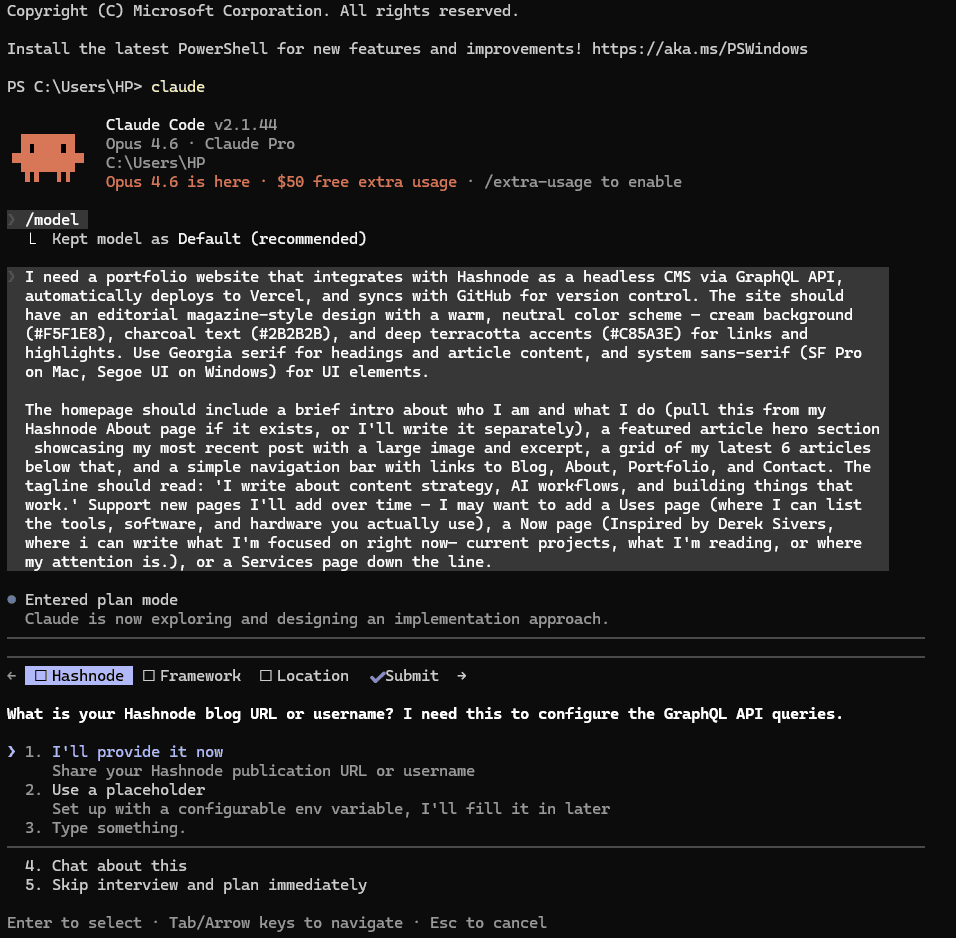
How I Built My Portfolio Website With Claude Code And How You Can Too
How a writer built a custom portfolio website using Claude Code, Hashnode as a headless CMS, and Vercel for hosting, from the first prompt to a live site.

Looking for content manager/strategy roles
I’m looking for work. Or rather, I’m looking for a new challenge. I’ve been a freelance writer for over six years, and I want that to change. I am seeking a content manager, junior content strategist, or an affiliated role. Preferably in a
What I Learned Vibe-Coding My First App (& Shutting It Down)
I vibe-coded Garde, a recipe & DIY video-to-text app, in November 2025 & shut it down four months later. Here’s what building it taught me.
Comments
Leave a thought, question, or response. Your email stays private. If you use an email linked to Gravatar, your profile image may show automatically.
Loading comments...