Case study
How I wrote 44 product-led articles for ManyRequests and made the product useful inside the piece
44
Articles published
22
High-fit topics where the product could be shown directly
Page one
For “Workfront alternatives” and “design annotation tools”
Active
Retainer still running
Overview
ManyRequests did not need more blog posts that mentioned the product once near the end and called that product-led content. They needed articles that could rank for the right searches, answer the reader properly, and show where the product fit while the reader was still making up their mind.
I’ve written 44 articles for ManyRequests over roughly 20 months. Most of them sit close to the bottom of the funnel. Comparison pages, alternatives pages, workflow guides, and operational topics where agency owners are already trying to decide what tool to use or how to run a cleaner system.
The goal was simple. Make the article useful enough to earn trust, then make the product feel like a logical next step inside the article itself.
That approach worked. According to Regine Garcia, Head of Content at ManyRequests, the product-led posts led to more traffic and demo requests.
Results at a glance
- 44 published articles across BOFU and product-adjacent agency operations topics
- 22 high-fit topics where the product could be explained and shown directly in the body
- Page one rankings for searches like "Workfront alternatives," "ClickUp vs Notion," and "design annotation tools" at the time of review
- Retainer still active
The challenge
A crowded category where the easy version of this work is familiar
ManyRequests sells client portal and agency management software for creative agencies and productized service businesses. That puts them in a crowded search space. They are competing with generic project management tools, alternatives sites, affiliate roundups, and bigger software brands with more authority.
The easy version of this work is familiar. Pick a comparison keyword, write a listicle, add the client’s logo at the top, mention the product in the conclusion, and move on. That kind of article can rank for a while, but it usually does a weak job of helping the reader understand why this product matters and how it helps.
ManyRequests needed something better. The brief was not just to publish content. It was to write articles where the product could do real work inside the body of the piece.
How I approached the work
Three things I did consistently across 44 articles
Step 01
I chose topics where I could explain how the product works inside the article
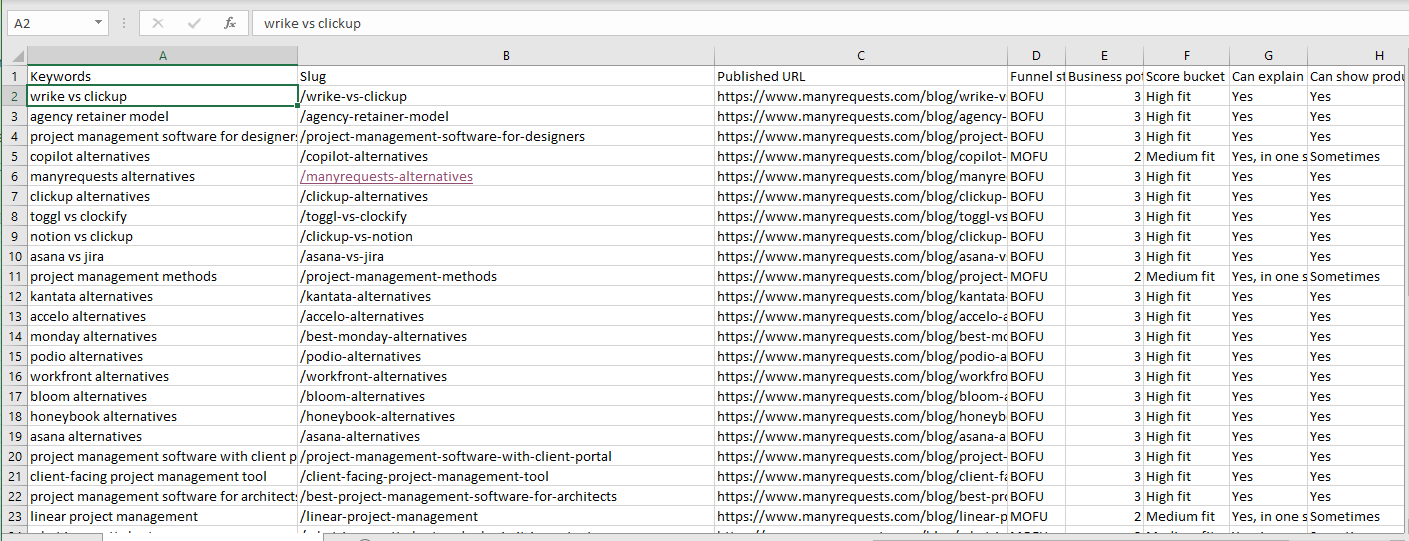
Before I wrote anything, I looked at each topic through a simple question: can I show the reader where ManyRequests fits before the article is over?
If the answer was yes, the topic scored higher (using the business potential score). If the fit was weak, I either changed the angle or treated the piece as broader educational content instead of trying to force the product into it.
That is what pushed the work toward topics like Workfront alternatives, ClickUp alternatives, client-facing project management tool, retainer management software, and design annotation tools. In those searches, the reader is already comparing tools or trying to solve an operational problem that ManyRequests actually helps with.
That filter also helped on broader topics like agency retainer model. It kept me honest. If the product could not help explain the workflow, I had no reason to wedge it into the piece.
Step 02
I showed the product through workflows, screenshots, and customer proof
Once a topic passed that first filter, I tried to make the product useful inside the article. Not visible. Useful.
That usually meant three things:
- Explain the workflow, not just the feature
- Show the product where a screenshot helps the reader understand the step
- Use customer examples where proof matters more than marketing copy
You can see that pattern clearly in the work.
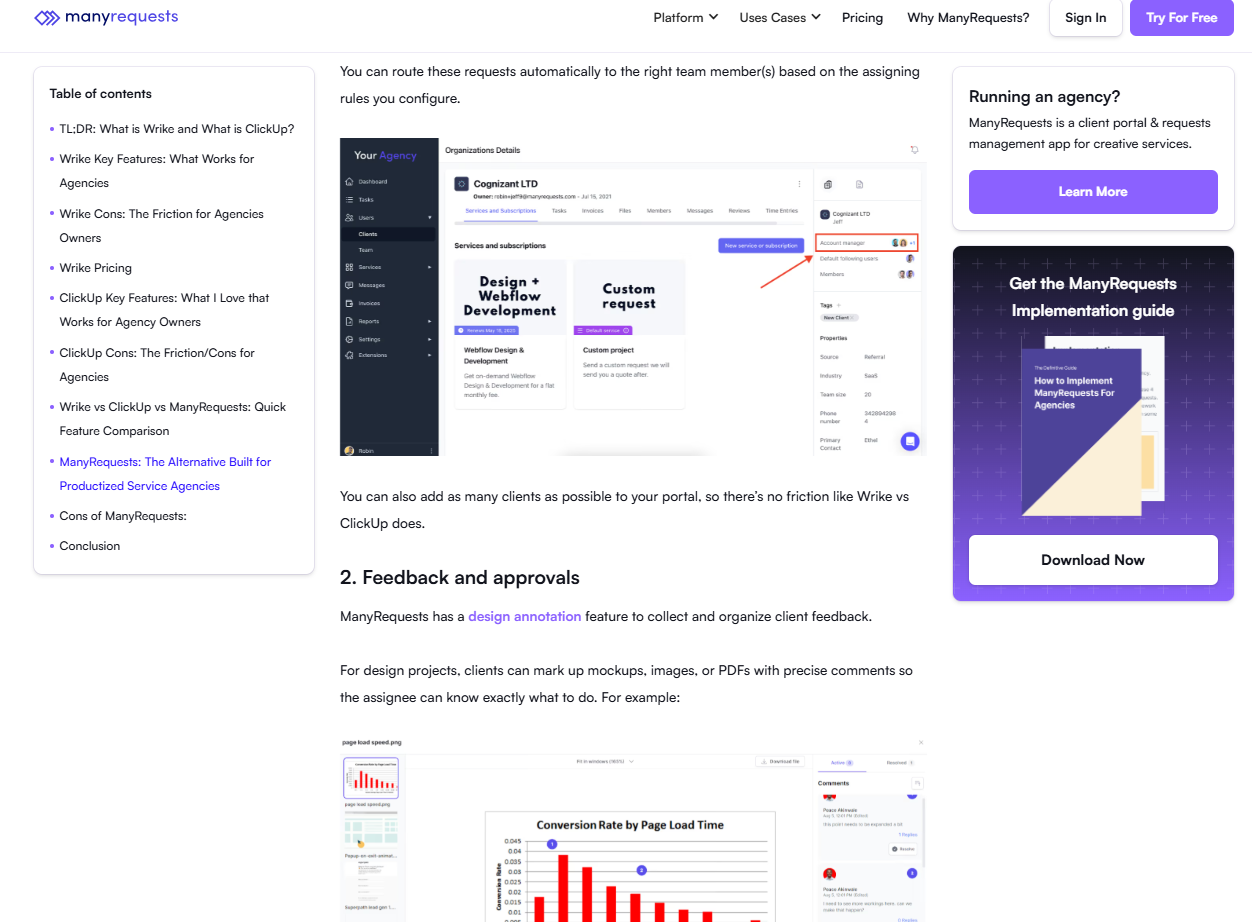
The reader is not just comparing task management tools. They are often trying to figure out what works for an agency that has to manage clients, approvals, billing, and delivery in one place. That gave me room to explain why a client portal, proofing, and white-label delivery matter in the first place, and where ManyRequests fits better than another internal PM tool.
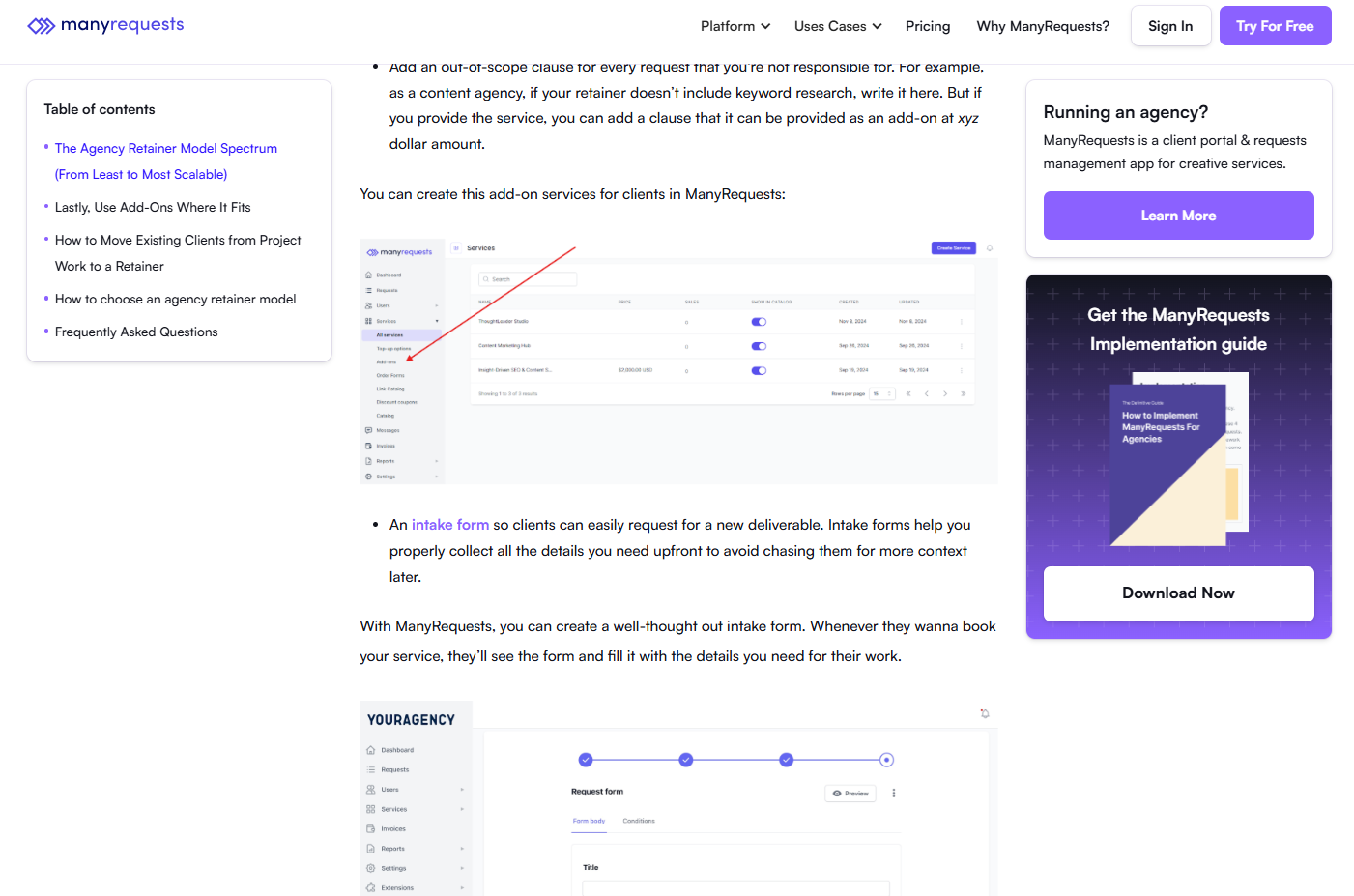
The product fit is less obvious at first, which is why I like it as proof. The article is teaching the reader how to structure and run a retainer. That gave me a practical place to show add-on services, intake forms, and cleaner request handling inside ManyRequests. The product was not tacked on. It was part of the operational advice.
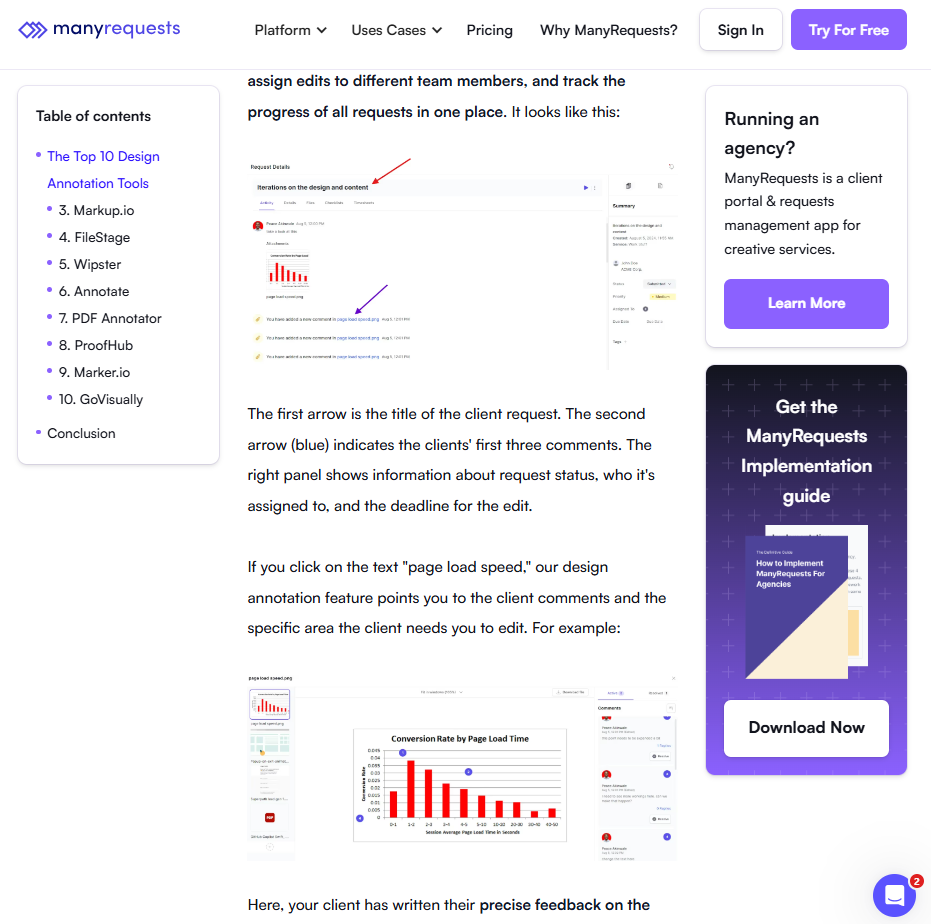
The fit is direct. The feature is the topic. That article let me explain the dashboard, markup flow, and video feedback with screenshots and concrete use cases instead of generic feature copy.
Step 03
I wrote each article to answer the next question a buyer would ask
Search intent gets someone into the article. It does not finish the job.
A reader searching “Workfront alternatives” is also wondering whether the alternative works for agencies, whether clients can submit requests cleanly, whether the team can manage billing, whether feedback stays organized, and whether the whole thing still works once the agency grows.
So I wrote the body to answer those follow-up questions inside the piece. That is part of what made the work feel product-led without turning it into a sales page. The product showed up where the reader naturally needed an answer, not where the brand wanted one more mention.
What this looked like in the work
Three articles that explain the whole approach
Wrike vs ClickUp
Shows how I handle hard comparison content. The article meets the search intent, but it also reframes the decision around what agencies actually need, not just what a general PM buyer might want.
Agency Retainer Model
Shows how I handle broader educational queries. The topic is not an alternatives page. The product has to earn its place through the workflow.
Design Annotation Tools
Shows the clearest version of the method. The product belongs in the article from the start, and the screenshots make that obvious.
The results
What the work produced
This work produced a large body of published content for ManyRequests and helped strengthen the bottom of their funnel around commercial and product-adjacent searches.
- 44 published articles across comparisons, alternatives, workflow guides, and agency operations topics
- Strong concentration around high-intent searches where ManyRequests had real product fit
- Page one visibility for "Workfront alternatives" and "design annotation tools" during review
- Ongoing retainer — which usually tells you as much as any vanity metric
“Peace specializes in product-led blog content, and it really shows in his work. He doesn’t chase keywords. He takes time to deeply understand the product, the user journeys, and how content can actually drive adoption and conversions. His top-performing posts are product-led ones, which has led to more traffic and demo requests for ManyRequests.”

Regine Garcia
Head of Content · ManyRequests
Figure 6 — SERP or Search Console proof
Add later if available — Search Console or SERP screenshot for rankings
What worked here was not just volume. It was product judgment.
The articles did not treat ManyRequests like a logo to attach at the end of a post. They used the product to help explain the problem, the workflow, and the decision the reader was already trying to make. That is what made the content more useful, and more commercial, at the same time.
Want articles like these for your product?
If your blog publishes regularly but the product never really shows up in the work, that’s usually where I start.